

Chief Product Officer and President, F&A Services
Volume without workflow redesign often leaves cash collected, days in AR and first-pass resolution where they were
Most healthcare leaders start AI programs with ambitious questions: How can we improve customer outcomes, reduce delivery costs, manage risk, and give people the skills to work alongside AI agents? Our customers are asking the same questions and applying AI to their own operations. Expectations for partners are rising.
The trouble begins when an AI program becomes a list of isolated use cases. Each use case becomes a task to automate. Success becomes units processed per hour.
A bot posts payments. A model reads denial letters. A copilot drafts appeals. Each tool can perform its task well while the workflow of cash collected, days in AR, and first-pass yield often change little. I call this the throughput trap.
Traditional revenue cycle pricing can reinforce the focus on volume. When services are priced per FTE or transaction, teams have a ready measure of productivity: how much work moves through the queue. Add AI without changing the workflow, and the old queue moves faster.
My view is simple: we need to examine the work itself. Where does information stall? Which handoffs create rework? Where can an AI agent act, and where does a person need to decide? Those answers should shape the workflow and its measures of success.
A faster queue is useful. A better revenue cycle is the goal.
The biggest gap sits between the provider and the partner
Most discussions of AI in revenue cycle look inside one organization. In practice, much of the work crosses a boundary. The provider registers the patient, documents the encounter and owns the systems. An RCM outsourcing partner handles coding, billing, follow-up or denials.
That boundary is where context is lost most often. The denial team rarely sees what was captured at registration. The coder does not hear what the payer said on the last follow-up call. Each side works its own queue, against its own targets, with a partial view of the account.
Adding AI on either side of the boundary does not close it. A faster denial tool on the partner's side still works without the registration data. A better front-end tool on the provider's side still does not learn from the denials it caused. The gap closes only when both sides design the workflow, the data, and the decisions together.
Why isolated AI tools stall
Isolated tools speed up steps. They do not fix the flow between steps. In most operations, the delay and the rework sit in the gaps: the handoff, the missing document, the decision waiting in someone's queue.
Two patterns show up again and again:
The bottleneck moves. Automate charge entry and the queue builds up at coding review. Faster intake only feeds a slower step downstream.
Errors travel faster. When a step is automated without a check on the data it receives, a wrong input is processed at higher speed and found later, at higher cost.
Start with the workflow, not the tool
Before choosing any AI tool, look at the work again through three lenses. A denial worklist shows how each lens changes the question.
1. Workflow: what is the outcome, and what really happens to get there?
Map the work end to end as it runs today, not as the SOP describes it. Include the loops, the rework and the waiting. Some steps exist only because two systems, or two organizations, do not talk to each other. Remove those steps. Do not automate them.
In the denial example: the throughput view asks how to work more denials per day. The workflow view starts upstream. It asks which denials came from registration, eligibility, authorization or coding, and which of those could have been stopped before the claim went out.
2. Data: what does each step need to know, and where does it come from?
For each step, list the data it uses, where that data lives and who changes it. Most delay comes from data that is late, incomplete or held in another system.
In the denial example: the agent that picks the next action needs the denial code, the payer's rules, the contract terms, the authorization record, the notes from past calls and the history of past appeals. Some of this sits with the provider, some with the partner and some on payer portals.
3. Judgment: where does a decision need a person?
Mark each step as one of three modes. The agent runs it. The agent recommends and a person confirms. Or a person decides, with the agent preparing the case. Use clear tests, not habit: the value at stake, the agent's confidence, how stable the payer's rules are, and whether the action affects the patient or the client relationship.
Teams usually get this wrong in two directions. They treat many routine steps as needing judgment, because experienced staff have always done them. And they underestimate the risk in a few steps, such as write-offs, timely filing decisions and appeals on high-value claims. In those steps, one wrong action can cost more than a week of saved effort.
In the denial example: resubmitting a claim after a simple coding or modifier fix can often run on its own. Choosing the appeal argument is a recommendation a person checks. Deciding to escalate to the payer, or to write off a balance, stays with a person.
Payers are automating too
Payers are also using AI in claim edits, prior authorization reviews and denial decisions. This changes the problem. The provider's workflow is no longer working against a fixed rulebook. It is working against another system that changes its rules, often without notice.
Changes in payer behavior show up first in the denials. If that signal stays in the partner's queue, the front end keeps making the same mistakes. A connected workflow sends what the denials teach back to registration, authorization and coding, quickly enough to matter.
Orchestrate agents and people around the outcome
Once the workflow is mapped through these three lenses, the design question changes. It is how agents and people share the work so the outcome is delivered with the least delay and the least rework.
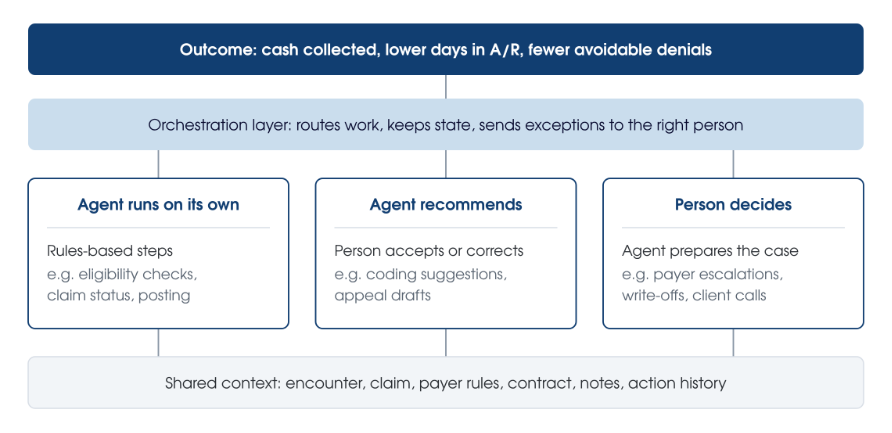
Agents run the flow on shared context; people own the judgment calls
Each step is placed in one of three modes, and an orchestration layer runs the flow across them. Four design choices matter most:
One shared context, across the boundary. Every agent and every person works from the same record of the account: what is known, what has been done, and what is pending. This is the hardest part. The data sits in the provider's EHR and billing system, on payer portals and in the partner's work queues. No one side owns all of it. Who connects it, who pays for it and who keeps it current must be agreed at the start, not found out later.
Clear handoff rules. The orchestration layer decides when an agent continues, when it stops, and which person gets the exception. Confidence thresholds, value limits and payer rules set these boundaries.
People at the decision points, not in the queue. Experienced staff should spend their time on the cases that need judgment. The agent should bring them the case already prepared, with the data and a recommended action.
A learning loop. Every correction a person makes is captured. It improves the rules and the agent's recommendations. Over time, it moves more steps from one mode to the next.
What changes for leaders
Measure the outcome, on both sides of the boundary. Units per hour and bot hours saved are useful inputs. The scorecard should lead with net collections, days in AR, first-pass yield, cost to collect and rework. Where the work is outsourced, the same measures should shape how the work is reviewed, so both sides are judged on the cause being fixed, not the queue being worked.
Fund the data before the agents. Connecting systems and building a shared record is less visible than a new AI tool. It is also what makes every later agent useful.
Redesign roles with the team. Much of the judgment in revenue cycle is payer knowledge held by experienced staff and never written down. Capture it while mapping the workflow. It is what the agents learn from. As agents take the routine steps, the remaining human work gets harder, so job design, training and quality checks must change with it.
Set the guardrails early. Decide upfront which actions an agent may take on its own, what needs approval, and how every action is logged and audited. In healthcare, this is a compliance need, not an option.
Start with one workflow, end to end. In the first 30 days:
Pick one specialty or payer group.
Pull 90 days of denials and tag each one to the step where it started.
Mark each step in the worklist by mode: agent runs, agent recommends, or person decides.
Agree the baseline: first-pass yield, denial rate, days in AR and rework.
Agree who owns each data source, on the provider side and the partner side.
Then run the redesigned workflow for a quarter and measure against the baseline.
Connected, not just faster
Adding AI to every step is easy to start and hard to scale. It produces activity, not outcomes.
The organizations that get real value from AI will not be the ones with the most tools. They will be the ones that redesigned the work first, together with the partners who do it.
If you are looking at your own denial or AR workflow this way, I would be glad to compare notes.

About Access Healthcare
Established in 2011, Access Healthcare remains at the forefront of healthcare management, allowing healthcare organizations to focus on what matters most: their patients. As a global leader, we are recognized as a trusted partner by healthcare organizations, offering a combined AI-embedded, automation, and human expertise revenue cycle management (RCM) operating model to drive visible results at scale.