
Leadership Perspectives
Get our latest thinking, thought leadership, and news. Subscribe to our newsletter to stay updated. If you would like to learn more about Access Healthcare, our service offerings and customer success stories, connect with us today.
Our Sid Mehta details how to focus on revenue cycle integration to strengthen connections and accountability between RCM teams.

AI accuracy gets the headline. How a system handles uncertainty decides whether the dollars arrive. Six questions to ask any AI vendor.
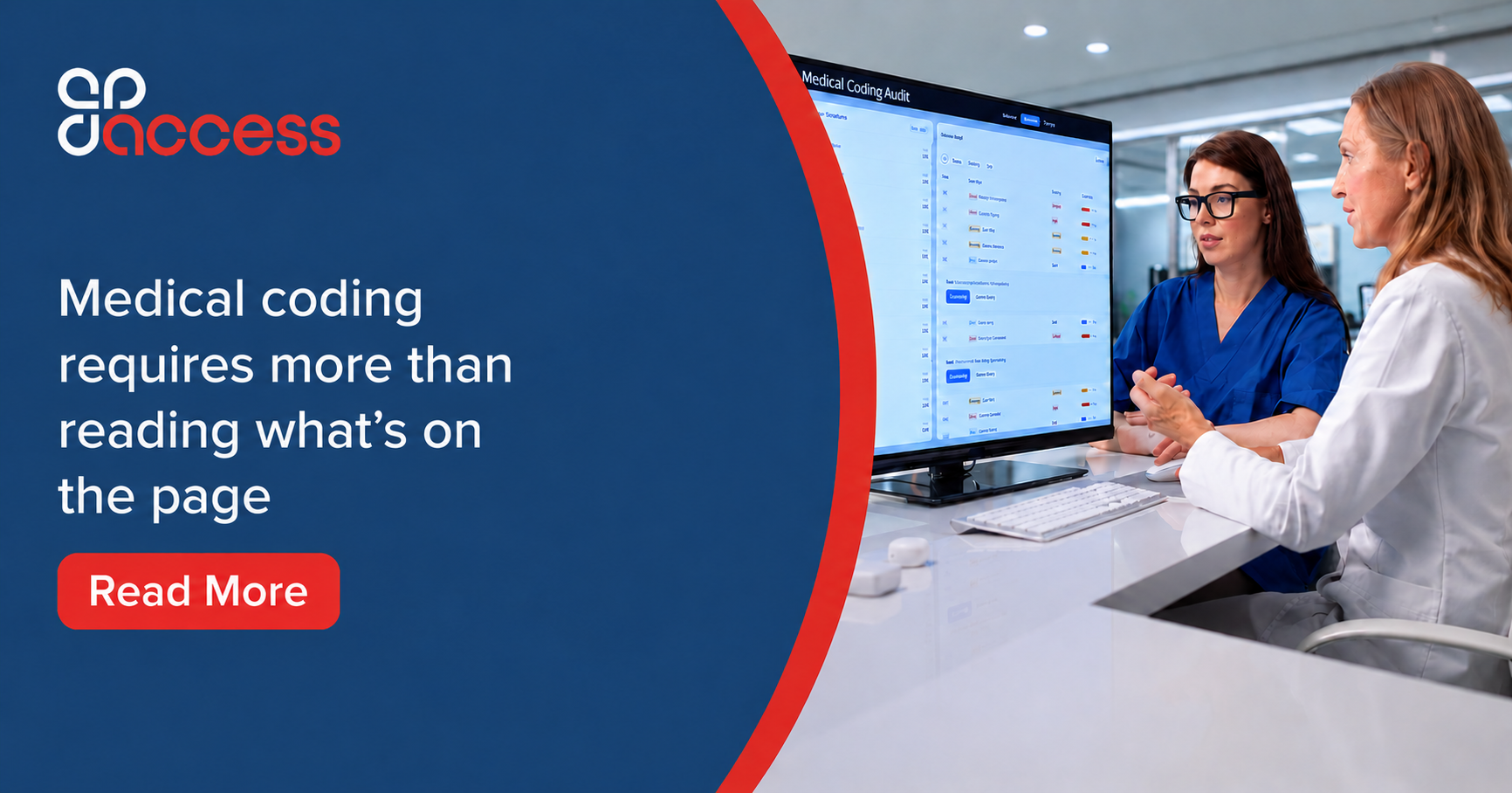
The coding automation question has changed. Not whether AI can code, but which charts it should code alone, and where the coder judgment goes when it does.

Human oversight of AI is not free. Putting a person on everything slows the revenue cycle and caps its scale. The skill is knowing where judgment belongs.

Health systems have spent the past decade investing in revenue cycle technology. Coding engines, denial predictors, eligibility tools, and workflow automation. Technology is deeper and more capable than it has ever been. Yet revenue still leaks through the seams, and for finance leaders watching margin absorb the difference, that leakage is not a rounding error. It is capital that should already be on the balance sheet.
Across healthcare technology and services, the instinct is often to sell clients the future: show them the roadmap, promise the destination, and ask them to make the leap. After more than two decades of leading client organizations, I have learned why that leap so often falls short. Clients do not operate in the future. They operate within the realities of their current systems, staffing models, payer contracts, operational constraints, and the revenue pressures landing on their desks this quarter.

Across healthcare technology and services, the instinct is often to sell clients the future: show them the roadmap, promise the destination, and ask them to make the leap. After more than two decades of leading client organizations, I have learned why that leap so often falls short. Clients do not operate in the future. They operate within the realities of their current systems, staffing models, payer contracts, operational constraints, and the revenue pressures landing on their desks this quarter.
The greatest test of an RCM partnership isn't how it performs today, but how well it performs after your organization has improved. A partner that helps stabilize today's revenue cycle should be able to support tomorrow's growth as well.

Ask most revenue cycle teams what eligibility verification does, and you will get a consistent answer: it confirms whether a patient is covered. Coverage confirmed, move on. Coverage not confirmed, follow up.
But, that framing is the problem.
Treating eligibility as a binary question, covered or not covered, creates blind spots throughout the revenue cycle. Under that mindset, an eligibility failure means someone was not covered, and nobody caught it. Fix it and move on. But the majority of eligibility-related denials do not come from uninsured patients slipping through. They come from coverage data that was technically confirmed but poorly understood: the wrong plan on file, a deductible that reset and was not recalculated, a coordination of benefits scenario that sent the claim to the wrong payer, a benefit detail that did not match what the service line actually required.

Every denial is evidence that something went wrong before the claim was created. A verification that did not happen. A prior authorization that was incomplete. Documentation that did not support the code. The denial itself is the last thing that occurs, not the first thing that went wrong. Organizations that treat it as the starting point will keep working the same volume of denials forever, because the conditions generating them never change.
Access Healthcare takes the long-term view of revenue integrity—by creating operational clarity, departmental collaboration, and smarter prevention at every step of the revenue cycle.
Obtaining prior authorizations quickly improves the overall patient experience and minimizes and, in most cases, eliminates service delays. This is how everyone wins.
Discover how modernizing patient access with Access Healthcare improves scheduling, pricing transparency, revenue growth, patient satisfaction and loyalty.

Shelley Badilla explains how payer policy changes create repeat work and how connected workflows help reduce denials and the cost of getting paid.